
Claiborne Parish Probate and Succession Records
Claiborne Parish probate court records are held by the Clerk of Court in Homer and available online through the ClerkConnect portal, with intact records dating to 1850 after a courthouse fire destroyed most earlier filings. The parish was created in 1828 but lost its first two decades of records in that 1849 fire, so researchers should plan for a gap in the collection before 1850. This guide explains how to search current records, what the succession files contain, what the 1849 gap means for your research, and how Louisiana succession law works in Claiborne Parish.
Claiborne Parish Quick Facts
Claiborne Parish Clerk of Court
Hon. Brian M. Flynn serves as the Claiborne Parish Clerk of Court. The office is at 512 E. Main Street in Homer. The mailing address is P.O. Box 330, Homer, LA 71040. Staff can be reached at (318) 927-9601 by phone or (318) 927-2345 by fax. The clerk's office handles all probate and succession filings, marriage records, divorce records, land records, and other civil court matters for the parish. Regular hours are Monday through Friday, 8:30 AM to 4:30 PM.
| Clerk | Hon. Brian M. Flynn |
|---|---|
| Address | 512 E. Main St., Homer, LA 71040 |
| Mailing | P.O. Box 330, Homer, LA 71040 |
| Phone | (318) 927-9601 |
| Fax | (318) 927-2345 |
| Hours | Monday-Friday, 8:30 AM - 4:30 PM |
Claiborne Parish was created on March 13, 1828, from northern Natchitoches Parish. It is a rural northwest Louisiana parish with Homer as its seat. The staff handles a manageable caseload and can assist families and individuals in navigating the succession process, including cases where no attorney is involved. If you plan to visit, calling ahead is a good idea so staff can confirm the records you need are accessible.
Online Search Through ClerkConnect
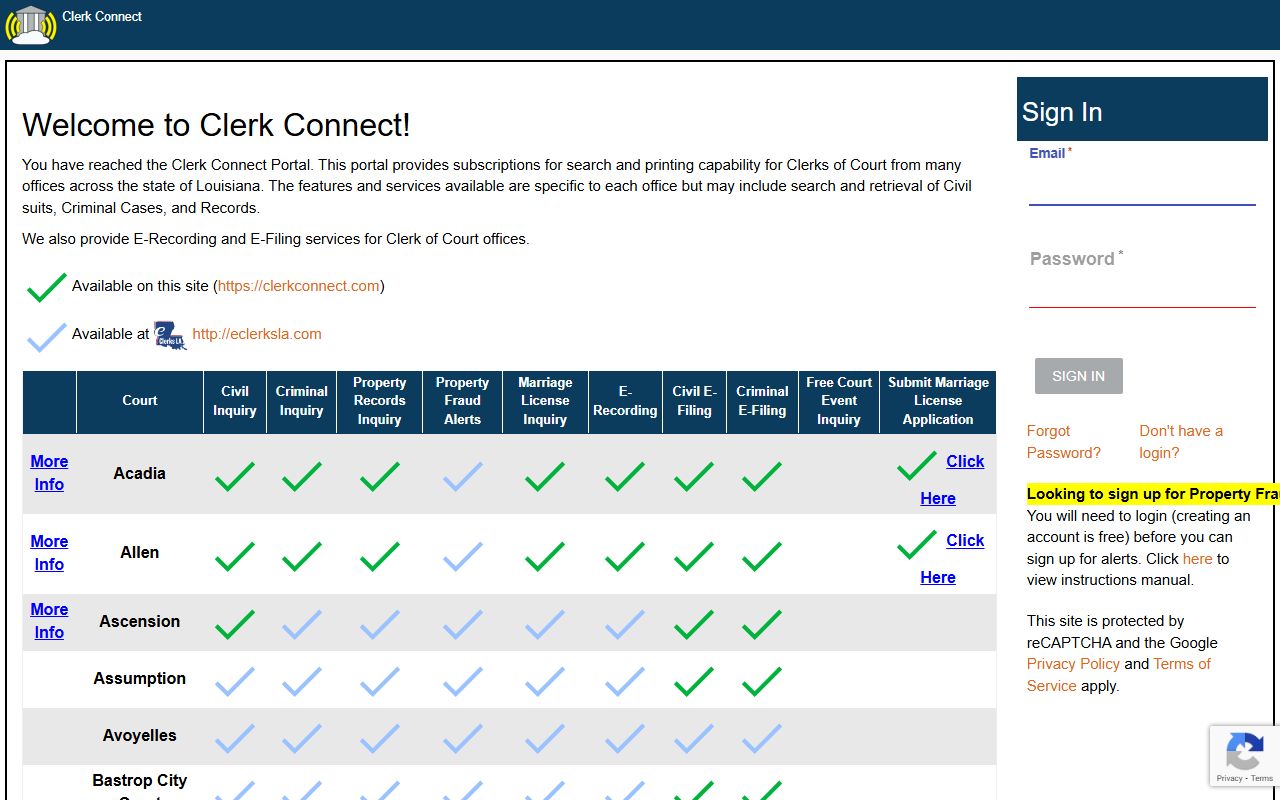
Claiborne Parish probate court records are searchable through the ClerkConnect portal. This statewide platform lets you search by name, case number, date range, or case type. Succession and probate cases are included in the searchable index. The portal gives you index-level access to case information, which is usually enough to confirm a case exists, get the filing date, and identify the case number before requesting full documents.
For document copies, you still need to contact the clerk's office directly. ClerkConnect shows what is on file in Homer, but certified copies and printed documents must come from the clerk at (318) 927-9601. Staff can help you confirm availability or explain the fee schedule before you visit or send a written request.
The 1849 Courthouse Fire and Record Gaps
Claiborne Parish was established in March 1828, but a courthouse fire in 1849 destroyed a large portion of the early records. As a result, the intact probate court records for Claiborne Parish start in 1850. Records from 1828 to 1849 are largely gone. A small number may have been reconstructed through affidavits, court orders, or materials held outside the courthouse, but researchers should expect significant gaps when looking for estates from that period.
For genealogical researchers focused on Claiborne Parish families before the fire, the Louisiana State Archives in Baton Rouge is the first place to check. The Archives sometimes holds copies or microfilm of records collected from alternate sources, including materials preserved outside the parish courthouse. Records from Natchitoches Parish, the parent parish from which Claiborne was formed, may also help fill in gaps for the pre-fire era.
From 1850 onward, the succession and probate record collection in Claiborne Parish is intact. This includes probate cases, marriage and divorce records, and land records, all held by the clerk's office at 512 E. Main Street in Homer.
What Probate Court Records Contain in Claiborne Parish
A Claiborne Parish succession file typically includes the petition to open the estate, any last will and testament filed with the court, an inventory of assets, creditor claims, court orders entered during the proceeding, and the judgment of possession at the close of the case. The judgment of possession is the document that formally transfers estate assets to the heirs. Title researchers frequently rely on this document when clearing ownership of land that passed through a succession.
Louisiana recognizes two main types of wills. An olographic will is handwritten in full and signed by the person who made it, with no notary required. A notarial will is typed or printed and signed before a notary and two witnesses. Both types become part of the public record when filed with the clerk as part of a succession. In some cases, a will may have been deposited with the clerk before the person's death, creating an earlier entry in the records.
Other documents that may appear in a Claiborne Parish succession file include affidavits of heirship, renunciations by heirs who decline their share, tutorship orders for minor children, and court orders authorizing the sale of estate property. Complex or disputed estates tend to have longer files with more hearing dates and orders.
All succession filings in Claiborne Parish are public records. Under R.S. 44:1, any person can request access to filed cases during business hours. No family connection or legal interest is required to view the record. Copy fees apply for printed documents, but viewing records in person at the Homer courthouse is free.
Louisiana Succession Law in Claiborne Parish
Louisiana succession law draws from French and Spanish civil law traditions and differs from common-law probate systems in most other states. A few key statutes govern how estates are handled in Claiborne Parish.
Civil Code Art. 871 states that succession opens the moment a person dies. The estate immediately becomes a legal entity. The filing of a petition with the Claiborne Parish Clerk of Court in Homer is what starts the formal court process through the 2nd Judicial District.
Where the succession must be filed depends on where the deceased lived. Civil Code Art. 873 requires the case to go in the parish of the deceased's domicile at the time of death. Claiborne Parish residents file in Homer. If the deceased owned property in other parishes, ancillary filings in those courthouses may also be needed to transfer title to out-of-parish assets.
Community property rules shape how a Claiborne Parish estate is divided. Civil Code Art. 876 separates assets into community and separate categories. Community property is what the spouses acquired together during the marriage. Separate property is what each owned before the marriage or received as a gift or inheritance at any time. The court must correctly classify each asset before distributing the estate. This matters most when a surviving spouse and adult children are both claiming interests in the same property.
Forced heirship is one of the most important differences between Louisiana and other states. Under Civil Code Art. 1493, children under 24 years old and children with permanent disabilities are forced heirs. They are entitled to a defined portion of the estate regardless of what a will says. The Claiborne Parish court must honor forced heirship claims before distributing the rest of the estate. A will that cuts out a forced heir can be challenged in the probate proceeding.
Small estates have a simpler option. Under R.S. 9:1555, when the net estate value is $125,000 or less and 90 days have passed since the death, heirs may use a small succession affidavit rather than opening a full court proceeding. This avoids court costs and attorney fees for modest estates. The Homer office can tell you what the affidavit requires and whether an estate appears to qualify.
Copy Fees for Claiborne Parish Probate Records
The Claiborne Parish Clerk of Court charges standard fees for document copies. Regular copies typically cost $1 to $2 per page. Certified copies, required for most legal and financial transactions, generally run $5 to $10 per document. Contact the office at (318) 927-9601 to confirm the current fee schedule before submitting a request.
In-person payments are usually accepted by cash or check. For mail requests, call first to get a cost estimate and confirm acceptable payment methods before sending anything.
Historical Records and Statewide Resources
The intact Claiborne Parish record collection begins in 1850. The clerk's office in Homer holds succession files, marriage records, land records, and divorce records from that year through the present. For records from before the 1849 fire, the Louisiana State Archives is the most reliable place to check for any surviving materials from that period.
The Louisiana Clerks of Court Association maintains a directory of every parish clerk in the state, which is useful for tracking estates that crossed parish lines or locating records in adjacent courthouses. The Louisiana Supreme Court website explains how the district court system works for those who want to understand how succession cases move through the courts and what to expect in contested proceedings.
Nearby Parishes
These parishes border Claiborne and also maintain probate court records through their clerks of court.