
Search St. Tammany Parish Probate Court Records
St. Tammany Parish probate court records document succession cases filed with the Clerk of Court in Covington since 1810. The 22nd Judicial District Court handles all probate and succession matters in the parish, and the Clerk's office maintains the official record for every case. St. Tammany offers online access through its public records portal, along with an Archives Department that holds older probate records from 1810 through 1996. This guide explains how to search, what fees apply, what records are available, and how Louisiana succession law shapes the process in St. Tammany Parish.
St. Tammany Parish Quick Facts
St. Tammany Parish Clerk of Court
Hon. Melissa H. Schmand serves as St. Tammany Parish Clerk of Court. The office is located at the St. Tammany Parish Justice Center at 701 N. Columbia Street in Covington. This is the primary location for in-person record access and all probate filings. The mailing address is P.O. Box 1090, Covington, LA 70434-1090.
| Clerk | Hon. Melissa H. Schmand |
|---|---|
| Address | 701 N. Columbia St., Covington, LA 70433 |
| Mailing | P.O. Box 1090, Covington, LA 70434-1090 |
| Phone | (985) 809-8700 |
| Hours | Monday-Friday, 8:30 AM - 4:30 PM |
| Website | sttammanyclerk.org |
The office is open Monday through Friday, 8:30 AM to 4:30 PM. Note that Protective Orders are not processed after 3:00 PM. If you plan to visit Covington for records research, call ahead or check the website for any schedule changes. The Justice Center houses both the Clerk's main office and the Archives Department, which is located at the basement level.
Online Access to St. Tammany Parish Probate Records
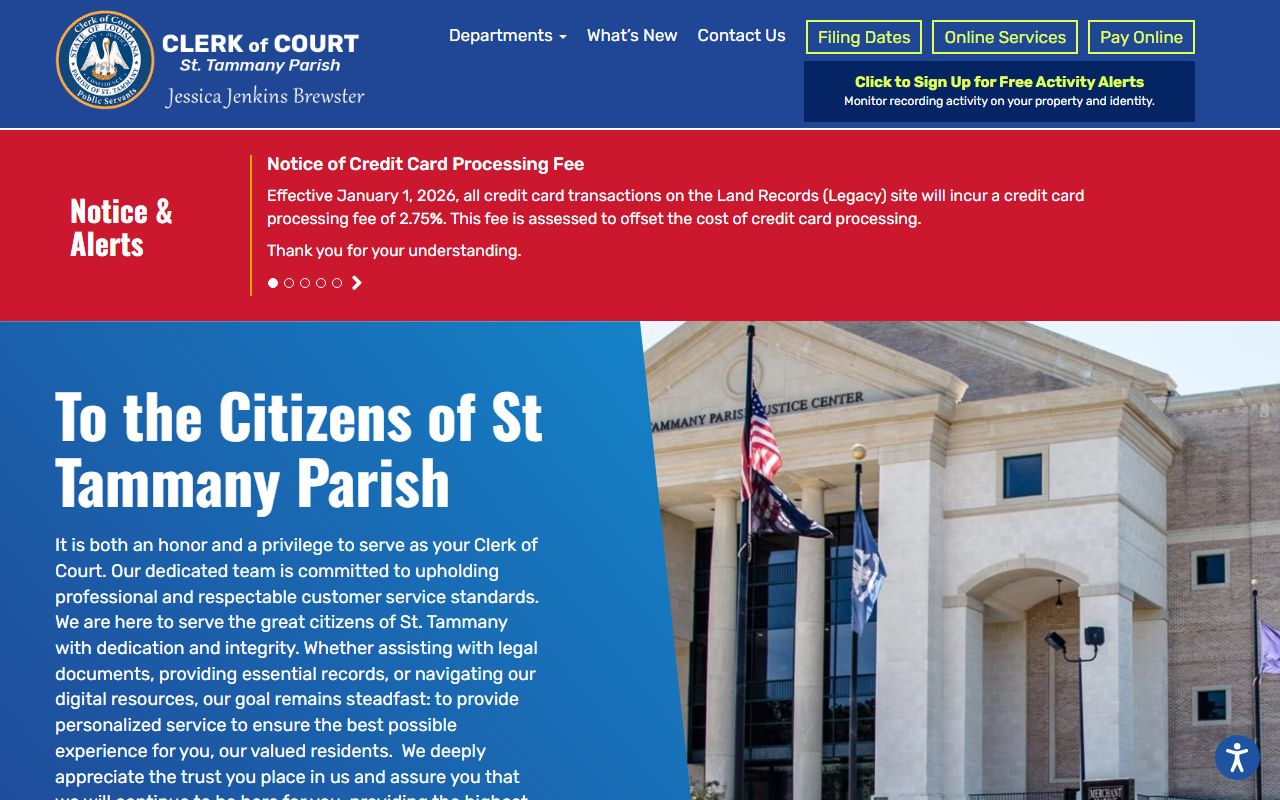
St. Tammany Parish offers robust online access to court records through the Clerk's public records portal at sttammanyclerk.org. The system includes Civil, Criminal, Land, and Probate records. Two separate platforms are available: the "Legacy" Public Records Program and Odyssey WebROA. Both are accessible through the Clerk's website.
The scope of digitized records varies by type. Mortgage and Conveyance records are available with data from 1961 forward and images from 1977 forward. Maps go back to 1810. Marriage records are available from 1810. Civil records are available from 1992, and Criminal records from 1988. For older probate records, the Archives Department holds physical records from 1810 through 1996.
Subscriptions are required for full online access. Pricing ranges from $20 per day to $360 per year. Individual document purchases may also be available. Check the Clerk's website for the current subscription options and pricing details. This system is useful for attorneys, title researchers, genealogists, and family members who need to review succession files remotely.
Under Louisiana R.S. 44:1, probate court records are public. Online access does not change this. The subscription fee covers the cost of the system, not the right to access. Anyone may subscribe and search St. Tammany Parish records through the portal.
Archives Department and Historical Probate Records
The Archives Department is a separate unit within the Clerk's office. It is located at the basement level of the St. Tammany Parish Justice Center. The Archives holds Succession and Probate records from 1810 through 1996. If you are researching a succession that was opened before 1992, the Archives Department is your primary resource for in-person access.
To reach the Archives Department directly, call (985) 809-8746. You can also email Archives@sttammanyclerk.org. Staff can search for specific files by name or approximate date and let you know whether a record is available. Copy fees apply: $1 per page for regular copies and $10 per certified document. Certified copies carry the clerk's official stamp and are typically required for legal or financial transactions.
For records from 1997 forward, the main Civil Department handles access. Older succession files in the Archives are especially useful for genealogical research and for tracing property chains tied to estates that transferred land over many decades. The Archives staff can help you understand what is available and in what format.
Copy Fees and Payment
St. Tammany Parish Clerk of Court charges the following fees for copies and certified documents from the Archives Department: $1 per page for regular copies, $10 per certified document. For vital records, birth certificates cost $34 and death certificates cost $26. These vital record fees are set by state law and apply uniformly.
As of January 2026, a credit card processing fee of 2.75% applies to payments made by card. E-Certification is available for certain documents, which allows you to receive a certified copy electronically. Ask the Clerk's office about eligibility for the document type you need. Cash and check payments may also be available; confirm acceptable methods when you place your request.
For online subscriptions, payment is handled through the portal at the time of purchase. Subscription fees do not cover copy costs for printed documents. If you view a record online and then need a certified copy for a legal matter, you will need to order it separately through the office or through the e-certification system.
What St. Tammany Parish Probate Court Records Contain
A succession file in St. Tammany Parish begins with a petition to open the succession. That petition identifies the deceased, the heirs, and the assets of the estate. As the case moves through court, additional documents are added. These typically include an inventory of property and debts, court orders appointing a succession representative, an accounting of how debts were paid, and a final judgment of possession that transfers assets to the heirs.
Wills filed in St. Tammany Parish are also kept by the Clerk. Louisiana recognizes olographic wills, written entirely by hand by the testator and signed at the end, as well as notarial wills, prepared and signed before a notary and two witnesses. A will may be found in a separate will index or within the succession case file. If a will was filed before a succession was opened, ask the Archives staff to search both indexes.
The Clerk's office also maintains marriage records from 1810, land records, civil judgments, and criminal files. These can all connect to a succession case. For example, a civil judgment against the deceased may become a claim against the estate. A marriage record may be needed to establish the surviving spouse's rights. The Clerk's staff can help you identify which records are relevant to a specific research need.
Louisiana Succession Law in St. Tammany Parish
The same succession laws that apply across Louisiana govern cases in St. Tammany Parish. Civil Code Art. 871 states that a succession opens at the moment of death. The estate is administered in the parish where the deceased was domiciled. For St. Tammany Parish residents, that means filing in Covington with the 22nd JDC. Civil Code Art. 873 sets out the domicile rule in more detail.
Forced heirship applies to all Louisiana successions. Under Civil Code Art. 1493, children under 24, and children of any age who are permanently incapacitated, have a legal right to a portion of the estate. A will cannot cut them out. If forced heirship is disputed in a St. Tammany Parish succession, the 22nd JDC handles that challenge. These disputes often produce substantial additional filings in the case record.
Community property rules under Civil Code Art. 876 determine how marital assets are divided. In Louisiana, assets acquired during marriage generally belong equally to both spouses. When one spouse dies, their half of the community property passes through succession. The surviving spouse keeps their share outright. Separate property follows its own rules. This distinction matters in succession filings and can make some St. Tammany Parish estate cases complex, especially for long marriages with significant assets.
For small estates, R.S. 9:1555 allows heirs to use a small succession affidavit instead of a full court proceeding, provided the net estate value is $125,000 or less and at least 90 days have passed since the death. A notary typically prepares the affidavit. The Clerk's office can confirm the filing requirements if you decide to go this route.
Additional Resources
The Louisiana Supreme Court website provides general information about the court system and links to self-help materials related to probate and succession. It is a good starting point if you are new to the process. The Louisiana State Archives in Baton Rouge holds historical records from parishes statewide and can supplement what is available through the St. Tammany Archives Department.
The eClerks LA platform covers electronic filing and access options across Louisiana parishes. For remote access to St. Tammany Parish records specifically, the Clerk's own portal at sttammanyclerk.org is the primary resource. The ClerkConnect platform is used by many other Louisiana parishes and may be relevant if you also need records from neighboring areas.
Legal aid organizations serve St. Tammany Parish. If you need help with a succession and cannot afford an attorney, contact local legal aid to ask about eligibility. For complex estates, an attorney with Louisiana civil law experience is strongly recommended, especially when forced heirship, contested wills, or significant property is involved.
Nearby Parishes
These parishes border St. Tammany and maintain probate court records through their own clerks of court.