
Find Lafayette Parish Succession Records
Lafayette Parish probate court records include all succession cases, estate filings, wills, and related documents filed with the Clerk of Court in Lafayette since 1823. The 15th Judicial District Court handles probate and succession matters for the parish. The Clerk's office provides free index searches online through the eClerks LA portal, with paid subscriptions available for full document access. Succession cases are filed in the Civil Division, and a dedicated Succession Department handles these cases directly. This guide covers how to find records, what they contain, and what Louisiana law requires.
Lafayette Parish Quick Facts
Lafayette Parish Clerk of Court
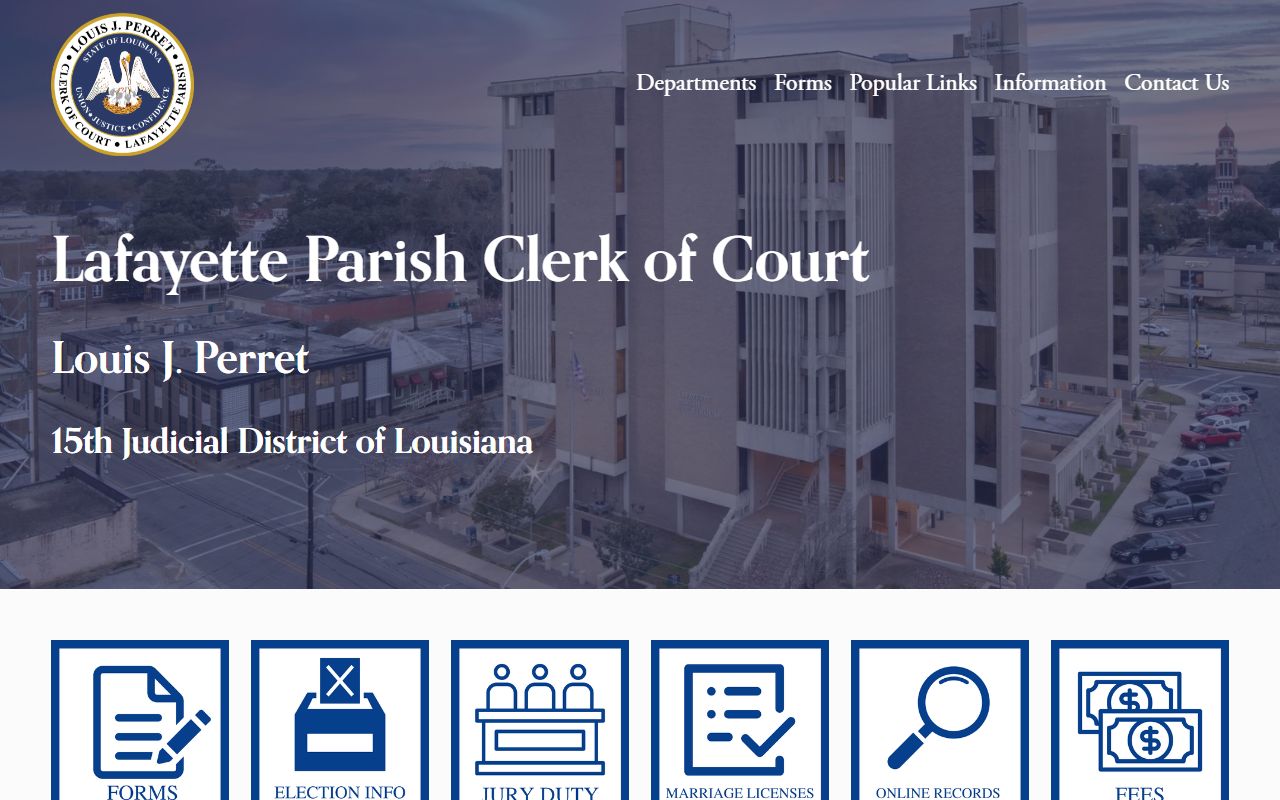
Hon. Louis J. Perret is the Clerk of Court for Lafayette Parish. The office is at 800 South Buchanan Street in Lafayette. The mailing address is P.O. Box 2009, Lafayette, LA 70502. The main line is (337) 291-6400. Fax is (337) 291-6392. For succession matters specifically, call the Succession Department at (337) 291-6312. General email inquiries go to clerkofcourt@lpclerk.com.
| Clerk | Hon. Louis J. Perret |
|---|---|
| Address | 800 South Buchanan Street, Lafayette, LA 70501 |
| Mailing | P.O. Box 2009, Lafayette, LA 70502 |
| Phone | (337) 291-6400 |
| Succession Dept. | (337) 291-6312 |
| Fax | (337) 291-6392 |
| clerkofcourt@lpclerk.com | |
| Hours | Monday-Friday, 8:30 AM - 4:30 PM |
| Website | lpclerk.com |
The office is open Monday through Friday from 8:30 AM to 4:30 PM. Death certificates are available at the courthouse but must be requested before 3:30 PM. The Lafayette Parish courthouse has strict security rules. Cellphones, recording devices, cameras, smart watches, tobacco, and weapons are not allowed inside. Plan accordingly if you are visiting in person to review probate court records or speak with the Succession Department.
Online Access to Lafayette Parish Probate Records
Lafayette Parish offers a free index search for land, civil, marriage, and probate records through the eClerks LA portal at lpclerk.com. You can search for a case by name or case number at no cost. The index search will tell you whether a record exists and show basic case details. To view full document images, you need a paid subscription. Monthly subscriptions cost $50 for 30 days of access.
The index covers records from April 20, 1961 onward. Probate and civil document images are available from May 24, 2006 forward. Older records, including succession files going back to 1823, exist at the clerk's office in physical form and may be available on microfilm. For those, you would need to visit in person or submit a mail request. eRecording is available for subscribers who need to record land documents remotely.
The eClerks Alert feature lets subscribers set up notifications for land record activity. This is useful for attorneys, title companies, and others who monitor property records regularly. It is not specific to probate records, but it can be helpful when tracking whether a succession has resulted in a conveyance or mortgage filing tied to real property in the estate.
How to Search Lafayette Parish Succession Records
Start with the free index search at lpclerk.com. Enter the name of the deceased or the succession representative. If you know the approximate filing year, use the date range filter to narrow results. The index will return case numbers and filing dates for matching records.
Once you locate the case number, you can pull up the document images if you have a paid subscription, or you can take the case number to the clerk's office and request copies in person. In-person access is available at the South Buchanan Street office. Public terminals are available for searching. For succession cases, it is best to contact the Succession Department at (337) 291-6312 before visiting to confirm the file is on-site and ready to view.
Mail requests go to P.O. Box 2009, Lafayette, LA 70502. Include the name of the deceased, the approximate year, and the documents you need. The office will confirm the record and provide a cost quote. Copy fees are $1 per page for uncertified copies and $3 per page for certified copies. Certified copies carry the clerk's official seal and are typically required for legal and financial transactions.
Death certificates are also available at the courthouse for $26 per copy, payable in cash only. Requests must be submitted before 3:30 PM. Birth certificates cost $34.
What Lafayette Parish Probate Court Records Contain
A succession file in Lafayette Parish starts with a petition to open the succession. The petition names the deceased, lists the surviving heirs, and describes the known assets and debts. As the case moves forward, the file grows to include an inventory of property, an accounting of debts, court orders, and ultimately a judgment of possession. This final judgment is the document that formally transfers estate property to the heirs and closes the case.
Wills are part of the probate record. Louisiana recognizes olographic wills, which are entirely handwritten and signed by the testator, and notarial wills, which require a notary and two witnesses. Both become public records once a succession is opened. If a will is contested, that litigation also becomes part of the case file. The full file may include multiple hearings, briefs, and court orders before a contested succession is resolved.
Under Louisiana R.S. 44:1, court records are public. You do not need to be a party to the case or a relative of the deceased to view a probate file. Most of the file is open to anyone who requests it. Some sensitive information may be handled with care, but the core succession documents are available to the public.
Other records kept in the Lafayette Parish Clerk's office include civil suits, criminal records, family court cases, marriage licenses (from the 1800s), conveyances, and mortgages. Property records in particular can be closely tied to succession cases, since real estate is often the main asset in an estate.
Louisiana Succession Law and How It Applies in Lafayette Parish
Louisiana uses civil law for succession rather than the common law that governs most other states. The rules are different and sometimes surprising to people used to common-law probate. Civil Code Art. 871 states that the succession opens at the moment of death. Under Civil Code Art. 873, the case must be filed in the parish where the deceased was domiciled. For Lafayette Parish residents, that means filing with the 15th JDC Clerk of Court on South Buchanan Street.
Louisiana's forced heirship rules are set out in Civil Code Art. 1493. Children under 24 years old and permanently disabled children of any age are forced heirs. They are entitled to a portion of the estate called the legitime, which no will can take away. This rule applies regardless of what the will says. If a will attempts to cut out a forced heir, that heir can challenge the will in court. Such challenges add documents and hearings to the succession file.
Community property rules under Civil Code Art. 876 apply to most married residents. Assets built up during a marriage are owned half by each spouse. When one spouse dies, only their half passes through succession. The surviving spouse keeps their own half without going through the court process. Separate property, which includes assets owned before marriage or received during marriage by gift or inheritance, follows different rules and may pass to different heirs than community property.
For smaller estates, R.S. 9:1555 offers a simplified path. If the net estate value is $125,000 or less and at least 90 days have passed since the death, heirs may be able to use a small succession affidavit rather than opening a full proceeding. The Lafayette Parish Succession Department at (337) 291-6312 can confirm what is required, but cannot provide legal advice about whether the simplified process applies to a particular estate.
Additional Resources for Lafayette Parish Succession Cases
The Louisiana Supreme Court website provides general information about the court system and self-help materials for people who want to understand how probate and succession work in Louisiana.
The Louisiana State Archives holds historical records statewide. For very old succession files, or for records predating the clerk's organized filing system, the Archives may have microfilm or other materials that complement the clerk's records.
Legal aid organizations serving the Acadiana region can help income-qualifying residents navigate the succession process. If cost is a concern, ask the clerk's office for a referral to local legal aid services. The Louisiana State Bar Association also has a lawyer referral service for those who need private representation.
Nearby Parishes
These parishes are adjacent to Lafayette Parish and maintain their own probate court records through their clerks of court.